
Dear Springboard:
I’m noticing that my team is busy, responsive, and technically productive—but also distracted, exhausted, and less thoughtful than they used to be. I feel it too.
We move fast, yet it rarely feels satisfying. How do I lead effectively in an environment that never seems to slow down?
Sign me,
Always On, Never Settled
Dear Always On:
What you’re describing isn’t a motivation problem. It’s a stimulation problem.
I recently learned about a central paradox we all live with. Pleasure and pain share the same neural pathway, and our brains use a balance (like a seesaw) to moderate the two.
On the Hidden Brain podcast, editor Shankar Vedantam interviewed psychiatrist Dr. Anna Lembke about her book Dopamine Nation.
Lembke explained when we experience pleasure and get a dopamine hit, our brain automatically counteracts this.
She said imagine gremlins jumping on the other end of the seesaw to bring our chemistry into balance. To do so, they overcompensate and bring us down – to a rebound of pain.
It’s not just bringing the brain chemistry into balance, it’s also priming us to seek more dopamine hits. When our ancestors were scavenging for food and shelter, this priming was a motivator to keep us going and do what was needed to survive.
This dynamic explains one of the reasons why excessive time on social media and scrolling entertaining videos leads to anxiety and depression. Lots of dopamine hits followed by a letdown, followed by seeking more dopamine hits.
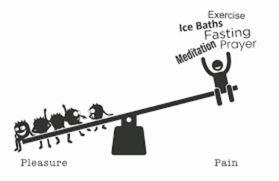
Similarly, in our broader lives, most of us are experiencing way too much stimulation. Lembke likens are our smart phones to digital hypodermic needles – ever-present and so available.
Because the brain is wired to seek balance, the opposite is also true. If we experience pain, we get a pleasure rebound. This explains the benefits of ice baths, vigorous exercise and challenging effort.
Because this dynamic offers motivation for doing things we associate with pain, I often think about this when walking our dog in wet, windy and bitter cold winter mornings.
I heard years ago that sometimes we need to do things we don’t want to do so we can feel better afterward. Now, here’s the science to back that up.
What does all this mean for you?
I believe all change starts with awareness. So, understanding this process offers a chance to reduce our dopamine hits and so feel better.
Dopamine is the brain’s “wanting” chemical. It drives anticipation, pursuit, and achievement. That’s great for leaders—until it’s constant.
When dopamine is repeatedly spiked by emails, deadlines, praise, metrics, and even problem-solving, the brain tries to rebalance. And it does that by producing the opposite state: irritability, anxiety, numbness, or exhaustion.
Here’s the paradox: the harder we push for productivity and satisfaction, the more depleted we can feel.
When leaders are caught in dopamine overload, they:
- Automatically reach for their phone
- Respond instantly to every message
- Reward speed over depth
- Treat urgency as a proxy for importance
- Fill every gap with activity or meetings
Leaders who restore balance behave differently. Instead of smoothing every friction point, they allow focus to feel effortful. They don’t rush silence in meetings. They expect complex thinking to take time. They model patience when answers aren’t immediate.
These leaders shift to meaning. Rather than just pushing harder, they reconnect the work to purpose.
They recognize that healthy effort builds confidence and resilience.